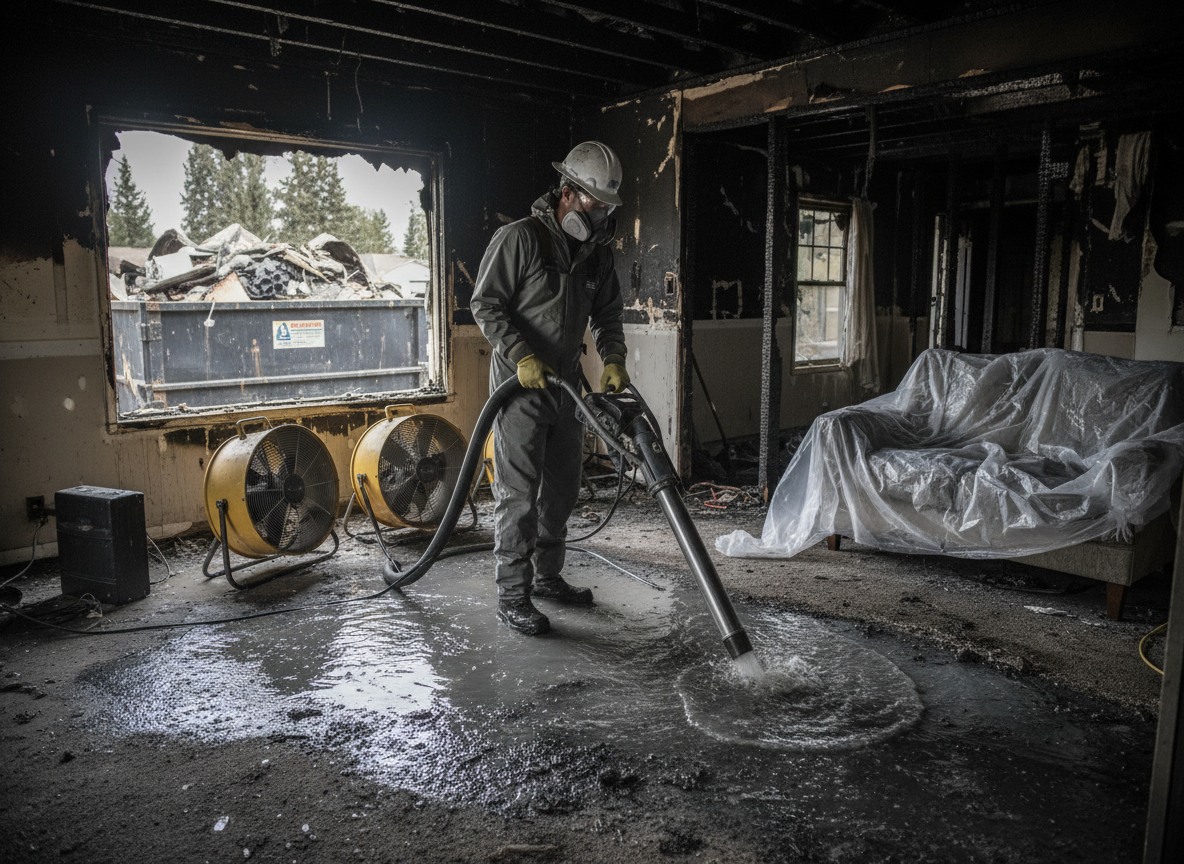
Edwards sits in high desert terrain where hot summers and cool winters combine with dry winds to increase wildfire risk around Edwards Air Force Base and nearby Mojave and Lancaster. When firefighters suppress a blaze they often use large volumes of water that quickly saturate older base housing stock built in the 1950s through 1970s. The water migrates into stucco walls, crawl spaces and attic insulation before the desert air can dry it, creating hidden pockets of moisture that lead to mold within days.
Remediation crews must separate smoke residue from water damage because soot on wet surfaces bonds to drywall and wood framing. In Kern County homes near the base, HVAC ductwork commonly runs through attics where temperature swings accelerate condensation on already damp metal. Technicians use moisture meters and thermal imaging to locate water that has traveled behind cabinets or under slab-on-grade floors common in Edwards ranch-style houses.
After extraction, drying equipment must account for low humidity days that can over-dry surface layers while leaving deeper wall cavities wet. Failure to address both the water and the alkaline residue from fire-suppression chemicals can cause ongoing corrosion of copper pipes and electrical boxes. Local crews schedule follow-up checks during the first cool nights when dew points drop and hidden moisture reappears on interior surfaces.
Homeowners in Edwards often attempt their own cleanup with box fans, which spreads soot particles through the entire structure before professional containment is installed. Proper protocol requires negative air machines and HEPA filtration rated for the fine particulates found after structure fires in the high desert.
Technician insight
In Edwards, the thing that catches most people out with Water damage remediation after fire is how cool winter nights pull moisture back out of stucco walls that dried on the surface during the day, especially in the older base housing near the flight line.
Kitchen Fire Water Migration
A stove fire in a 1960s ranch home near Edwards Air Force Base prompted heavy water use by responders. Water traveled under the slab and into the HVAC plenum. Crews extracted the water, ran targeted drying for five days, and confirmed dry readings before returning the home to the owners.
How it works
- 1
Site Assessment
Technicians inspect all affected rooms, attics and crawl spaces using moisture meters and infrared cameras to map water migration from firefighting efforts.
- 2
Water Extraction
Industrial pumps and wands remove standing water from floors and wall cavities before it can wick further into framing or slab edges.
- 3
Drying and Dehumidification
Air movers and low-grain dehumidifiers run continuously, with daily monitoring adjusted for Edwards temperature swings between day and night.
- 4
Smoke and Residue Removal
HEPA air scrubbers and specialized cleaners address soot and fire-suppression chemicals left on wet surfaces throughout the property.
- 5
Final Verification
Post-drying moisture readings confirm levels match unaffected areas before any reconstruction or occupant return.
Pricing
Pricing varies with the volume of water introduced during firefighting and the number of affected building materials.