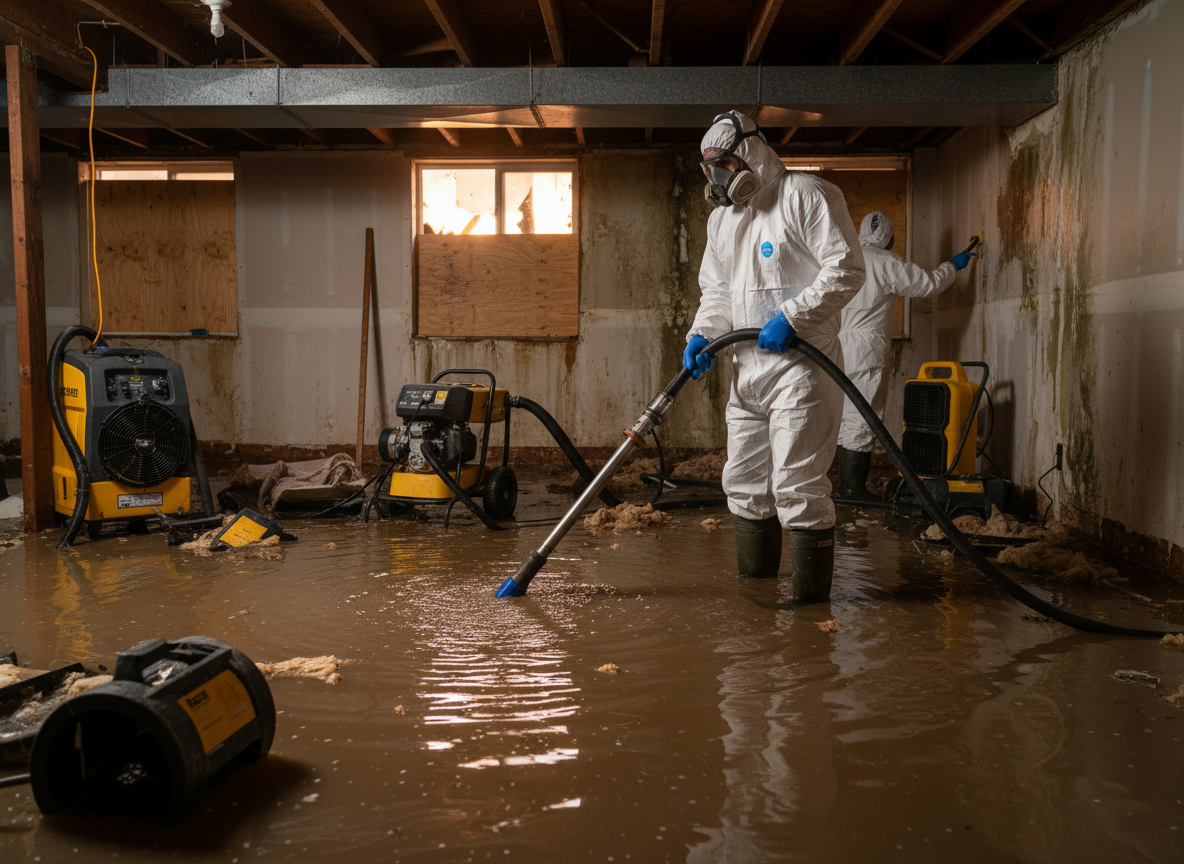
Edwards sits in Kern County high desert where sudden summer thunderstorms send water across packed soil and into older base housing built on slab foundations. Water enters through utility penetrations and low window wells common in 1950s-1970s military quarters, then migrates under vinyl tile and into wall cavities before residents notice. Extraction must account for the fine Mojave dust that mixes with floodwater and slows evaporation even when temperatures climb above 100 degrees.
We begin by mapping moisture with meters because desert air masks hidden saturation in drywall and underlayment. Contaminated water from street runoff or base drainage ditches often carries silt that requires removal of affected subfloor sections rather than simple drying. In Lancaster and Mojave border homes we see the same pattern when winter cool fronts stall over the valley and drop heavy rain on already compacted yards.
Air movers and dehumidifiers run longer here than in coastal zones because low humidity pulls moisture out unevenly, leaving pockets behind baseboards and in HVAC returns. We document every step for insurance adjusters familiar with Edwards Air Force Base claims and coordinate access through base security when the job crosses onto federal property.
Final clearance testing confirms readings below 12 percent before any reconstruction because returning military families need assurance the structure is truly dry before furniture arrives.
Technician insight
In Edwards, the thing that catches most people out with Flood restoration services is how quickly high desert wind dries the surface while water stays trapped under the slab in 1960s base housing. Homeowners turn the AC on thinking it helps, but the cool air just condenses against the still-wet concrete and restarts mold growth before we even arrive.
Runoff into base duplex after monsoon cell
Heavy rain funneled water under the front door of a 1970s duplex on base. Meters showed saturation extending four feet into the living room slab. We extracted standing water, placed drying mats under the vinyl, and ran equipment for six days until readings stabilized. The family moved back in without flooring replacement.
How it works
- 1
Emergency Assessment
Arrive on site within hours, document standing water depth, and identify entry points from desert runoff or base drainage.
- 2
Water Extraction
Remove bulk water using truck-mounted pumps suited for silt-laden floodwater common after Kern County storms.
- 3
Drying and Monitoring
Place commercial drying equipment and track moisture daily in slab homes typical around Edwards Air Force Base.
- 4
Sanitization and Clearance
Apply antimicrobial treatment where needed, then confirm dryness before any rebuild work begins.
Pricing
Upfront quotes after inspection; cost driven by water volume, affected square footage, and whether slab or crawlspace access is needed.