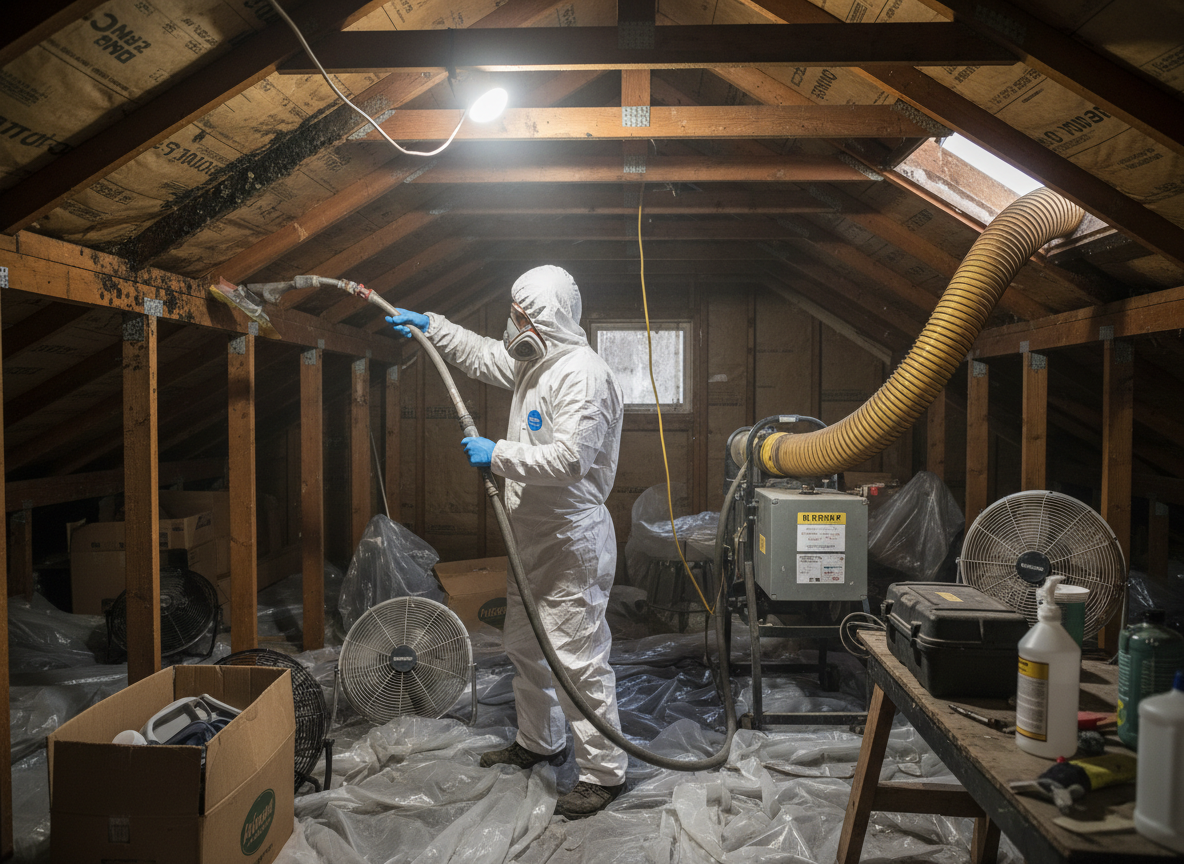
Edwards sits in Kern County’s high desert where hot summers and cool winters create daily temperature swings that drive condensation inside poorly vented attics. Military housing around Edwards Air Force Base and older single-family homes in nearby Mojave and Lancaster often have original insulation and limited ridge venting, allowing roof leaks or bathroom exhaust leaks to stay hidden until black mold appears on rafters. Removing the growth requires isolating the attic, HEPA vacuuming settled spores, and treating sheathing without disturbing the base’s dust and sand that already infiltrates every opening.
We begin by mapping moisture with infrared cameras because the dry air outside masks active leaks inside the insulation. Once the source is fixed we remove affected batts and cellulose, then apply an EPA-registered antimicrobial to rafters and plywood while running negative air machines that exhaust through roof jacks. Homeowners in Edwards notice the difference quickly; without proper containment, spores easily travel through the HVAC that many base-adjacent homes still use for both heating and cooling.
After treatment we install additional soffit and ridge vents sized for the home’s square footage and replace insulation with material rated for desert thermal cycles. This step prevents the rapid re-growth that occurs when winter nights drop below freezing and attics warm again the next afternoon. Every job ends with a post-remediation moisture reading below 12 percent and a written report for insurance or base housing offices.
Because Edwards properties sit on sandy, fast-draining soil, exterior grading around foundations rarely shows standing water, yet roof penetrations from swamp coolers and satellite dishes remain the leading cause of attic mold. Addressing those penetrations during remediation keeps the same moisture from returning the following season.
Technician insight
In Edwards the thing that catches most people out with attic mold remediation is the daily temperature swing between hot afternoons and cool nights that keeps driving condensation even after the leak is fixed; the older base housing around Edwards Air Force Base has minimal ridge venting and the sand that blows in from the desert makes it easy to miss active moisture behind the insulation.
Hidden Leak Above Master Bath in Edwards AFB Housing
A homeowner noticed musty odor after winter rains. Inspection found a cracked swamp cooler seal allowing water to run along rafters and soak cellulose insulation. We isolated the attic, removed the wet material, treated the plywood, and added ridge vents sized for the home. Moisture readings stayed under 12 percent and the odor did not return.
How it works
- 1
Inspection and Moisture Mapping
Technicians scan the attic with infrared and pin meters to locate active leaks and hidden mold colonies without disturbing settled dust.
- 2
Containment and Source Removal
Plastic barriers and negative air machines isolate the space while damaged insulation and affected wood are removed and bagged for disposal.
- 3
Antimicrobial Treatment
Rafters and sheathing receive an EPA-registered product followed by HEPA vacuuming of all surfaces and adjacent HVAC returns.
- 4
Ventilation Upgrade and Drying
New soffit and ridge vents are added and dehumidifiers run until wood moisture content reads below 12 percent.
- 5
Final Clearance and Documentation
Post-treatment readings and photos are provided along with recommendations for ongoing roof and exhaust maintenance.
Pricing
Cost depends on attic size, depth of insulation, and whether roof repairs are needed at the same time.